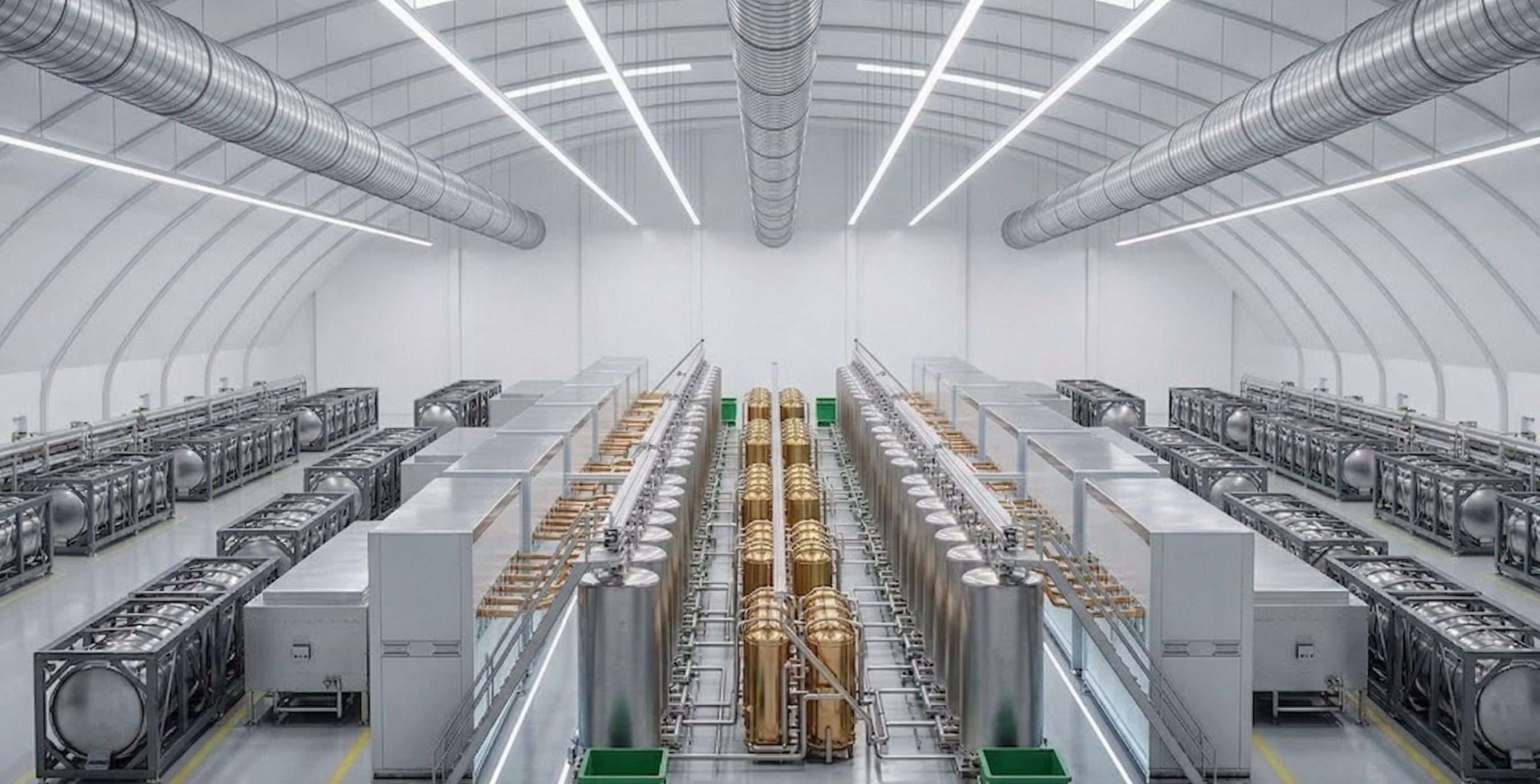
A manufacturing company. Not a waste company.
The distinction matters for Lagos State's balance sheet, regulatory posture, and long-term fiscal structure.
Carbotura builds, owns, and operates Advanced Circular Manufacturing (ACM) facilities under 30-year Circular Supply Agreements. The facility converts residual material streams — the MSW, organic fractions, and industrial residuals that currently require disposal — into synthetic graphite, graphene compounds, and recovered minerals using the MCR (Microwave Catalytic Reforming) process.
MCR is anoxic and oxygen-free. It is classified under manufacturing NAICS codes (Sector 31–33), not solid waste codes. Under a Circular Supply Agreement, the material Lagos State currently pays to dispose of becomes a manufacturing feedstock the State is paid to supply. The Beneficiation Fee (TMC Fee) replaces previously committed disposal spending. The Circular Royalty™, beginning 13 months later, returns more than was paid.
Lagos State operates Africa's highest-density urban waste stream. The December 2024 commencement of 18-month decommissioning programs at Olusosun and Solous III — Lagos's two largest operational landfills — has concentrated the disposal timeline in a way that creates a precise and measurable window for the CSA structure to be deployed. The Lekki Smart City development provides the infrastructure platform and planning authority context for Phase Initial deployment.
The Beneficiation Fee for this engagement is structured at $22 per ton, reflecting the contractual basis of this registry. The Circular Royalty™ at 120% of the current-year Beneficiation Fee delivers $26.40 per ton beginning Month 13 — a return that exceeds the fee from the first royalty payment, with escalation of +1 percentage point per year thereafter.
Why this matters — what Carbotura is offering Lagos State
Five structural facts that define the decision window for Lagos State's Lekki engagement.
In December 2024, Lagos State commenced 18-month decommissioning programs at both Olusosun and Solous III — the State's two largest operational landfills. Olusosun alone processed approximately 2,500 TPD. The Epe landfill has been closed. This creates a structural disposal gap that must be addressed through alternative infrastructure before the decommissioning timeline concludes. The CSA window is now open.
The December 2024 start date anchors the timeline. Eighteen months from commencement, both facilities are expected to cease intake. Lagos State requires confirmed alternative processing capacity for approximately 2,500+ TPD of previously Olusosun-directed waste. Phase Initial at 400 TPD addresses the first module of that requirement. The CSA scales to the full gap.
Lekki Smart City is a planned integrated urban development under Lagos State authority. Its planning mandate and infrastructure platform make it the natural anchor for Phase Initial deployment — bringing manufacturing NAICS classification into a development zone already oriented toward industrial and commercial uses distinct from traditional solid waste infrastructure.
At $22 per ton Beneficiation Fee, the Circular Royalty™ at 120% of the current-year Beneficiation Fee delivers $26.40 per ton from Month 13. Gross cost displacement is quantified separately from Circular Royalty™ cash flow per the Separate Transaction Principle. At steady state, the Circular Royalty™ is designed to exceed the Beneficiation Fee on a per-ton basis.
Six Lagos State legacy landfill sites have been identified as Exogenesis™ candidates: Olusosun (primary), Solous III, Epe, Abule Egba, Badagry, and Ikorodu. The combined legacy material characterisation represents a potential Exogenesis™ Royalty stream of institutional scale. All are subject to Waste Characterization Study and do not alter primary CSA terms.
Phase Initial at 400 TPD creates 285 direct Lagos-based FTE in manufacturing and operations. The CSA term of 30 years with perpetual continuation provides multi-generational employment certainty. At Phase Expanded, direct FTE scale to approximately 1,400+ Lagos State-based positions.
Two paths for Lagos State
- Beneficiation Fee: $22/ton, 2.5% annual escalator
- Circular Royalty™: 120% of the current-year Beneficiation Fee, +1pp/yr escalator
- Royalty commencement: 13 months after corresponding Beneficiation Fee payment (rolling monthly)
- 30-year CSA term, perpetual continuation language
- 18-month Parent Performance Guarantee
- Regulatory Predicate Transition (RPT) required
- IFRS accounting treatment
For Lagos State, six qualifying legacy landfill sites have been identified as Exogenesis™ candidates — the largest multi-site Exogenesis™ opportunity in the Carbotura portfolio. Each site may be structured as a separate dual-stream Exogenesis™ Royalty payment under agreements appended to the primary CSA.
- Olusosun — primary site; ~2,500 TPD historical intake; 18-month decommissioning active Dec 2024
- Solous III — 18-month decommissioning active Dec 2024
- Epe — closed; legacy characterisation candidate
- Abule Egba — legacy characterisation candidate
- Badagry — legacy characterisation candidate
- Ikorodu — legacy characterisation candidate
Key figures at a glance
Planning-basis estimates. ESTIMATED figures subject to site-specific verification. Figures denominated in USD; IFRS accounting applicable.
registry-confirmed rate
+1 pp/yr escalator thereafter
Lagos State-based manufacturing roles
Employment and economic contribution
Phase Initial (400 TPD)
Phase Medium (800 TPD)
Phase Expanded (2,000+ TPD)
Circular Royalty™ projections across deployment configurations
Gross Circular Royalty™ and Beneficiation Fee shown independently per the Separate Transaction Principle. All figures USD.
| Capacity | Annual TPY | Beneficiation Fee · Year 1 | Circular Royalty™ · Year 2 | 30-Year Gross Royalty | Direct FTE |
|---|---|---|---|---|---|
| 200 TPD | 73,000 | $1.61M | $1.93M | ~$100M ESTIMATED | ~143 |
| 400 TPD ← Lekki Phase Initial | 146,000 | $3.21M | $3.85M | ~$200M ESTIMATED | 285 |
| 800 TPD | 292,000 | $6.42M | $7.70M | ~$400M ESTIMATED | ~570 |
| 2,000 TPD · Phase Expanded | 730,000 | $16.06M | $19.27M | ~$1.0B ESTIMATED | ~1,400 |
Beneficiation Fee: $22/ton, 2.5%/yr escalator (registry-confirmed). Circular Royalty™ (Year n) = (120% + (n−1)pp) × that year’s Beneficiation Fee. Royalty payments begin 13 months after corresponding Beneficiation Fee payments. At steady state, the Circular Royalty™ is designed to exceed the Beneficiation Fee on a per-ton basis. Exogenesis™ Royalty streams (six candidate sites) addressed in the full Proposal document.